
The man behind the clock
Professor Ferdinand Alexander Porsche and the idea that changed everything.
All sizes shown for Porsche Lifestyle products are EU sizes. Please order one size larger for your standard North American size.
How a design idea changed watchmaking.
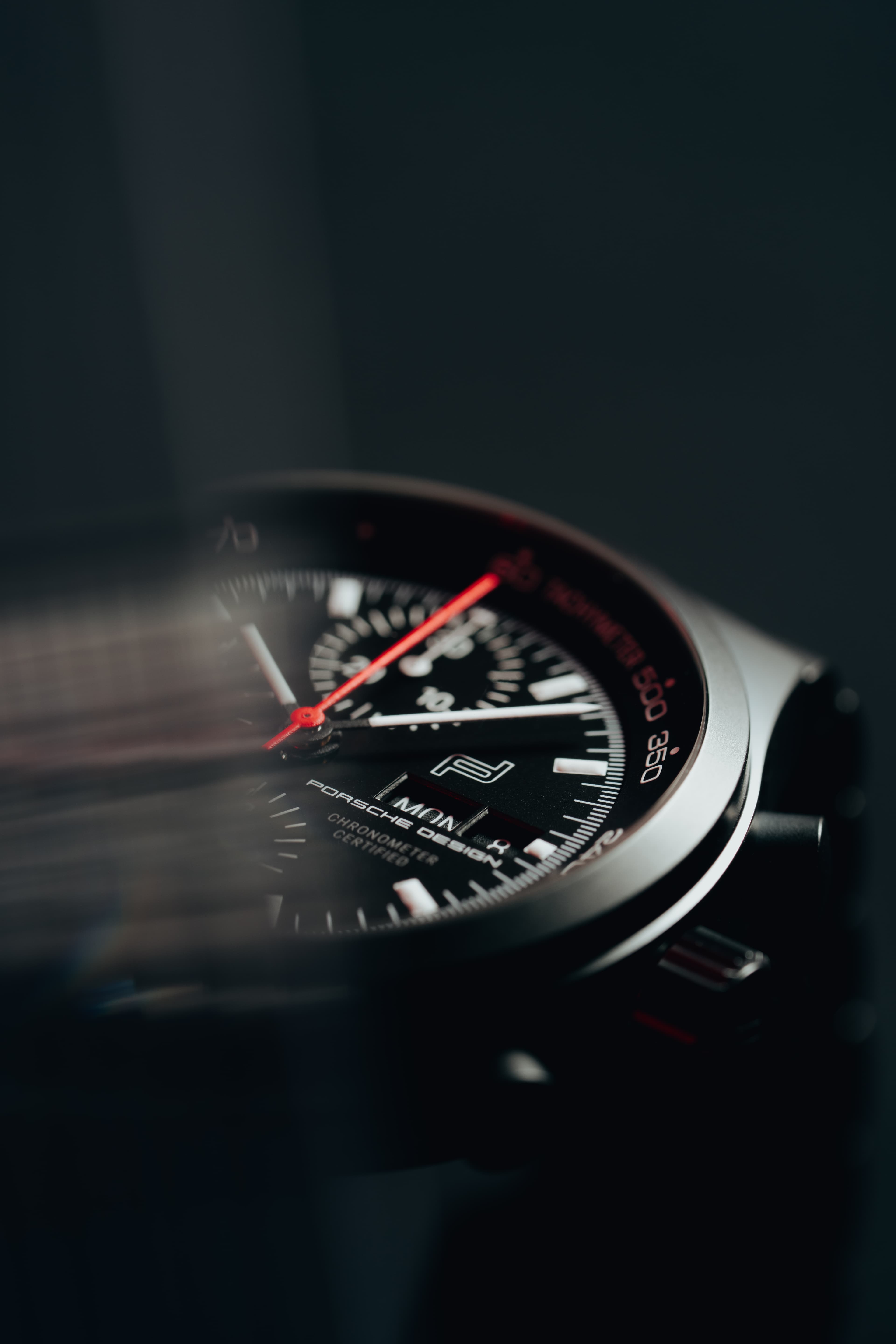
Since 1972, Porsche Design has used the watch both as a precise instrument and as a stage for new ideas. From the world's first Black chronograph to titanium cases, integrated pushers, and high-tech materials such as titanium carbide: the brand has consistently set trends that extend far beyond its own collection. What follows is a journey into the development of how Professor Ferdinand Alexander Porsche's design aspirations became genuine innovations – and what role partners such as Orfina, IWC or Eterna played along this path.

The Porsche Design Timepieces Manufactory designs each watch as an independent object, tailored to the requirements and wishes of an individual customer. The principle is not to produce one hundred watches once, but one watch a hundred times. Porsche Design is transferring what has been standard practice in sports car manufacturing for decades to the wrist: individual configuration, consistently implemented. The result is not a customised mass-produced product, but a true one-of-a-kind instrument.

Innovation at Porsche Design is not driven by the desire to appear more spectacular, but by the question of how a wrist instrument should behave. The displays in the cockpit of a Porsche 911 serve as a reference: clear, minimalist, and easy to read at all times. In 1972, Professor Ferdinand Alexander Porsche applied this exact principle to a watch. The first product of the Porsche Design brand was created on the basis of the design principles that defined the Porsche 911. The path led from early collaborations with Orfina, and later IWC and Eterna, to the Porsche Design Timepieces Manufactory with in-house calibre design and material and component development. In each phase, new solutions were tested that have had a lasting impact on the modern timepiece.

With the Chronograph I, introduced in 1972, Porsche Design established a completely new view of the watch. The timepiece, manufactured in collaboration with Orfina, was completely Black. The case, dial and strap were dark, and only the hands, indices and specific Red accents stood out clearly. What at first glance appeared to be a bold design statement was in reality a functional decision.
The matte Black finish reduces reflections and brings the White displays into focus. The colour distribution follows the logic of cockpit instruments: Black forms the stage, White conveys information, and Red marks the most important functions, which in this case are the chronograph displays. Together with Orfina, Porsche Design set a benchmark for the modern 'tool watch'. Colour was no longer used as decoration, but as a deliberate means of improving readability.

Following the initial launch in Black, a second fundamental innovation took place in the 1980s: the use of titanium as the material for an entire watch. In close cooperation with IWC Schaffhausen, Porsche Design developed chronographs and diving watches made entirely from this lightweight metal. Before this, titanium was primarily known for its use in aviation and motorsport. It is significantly lighter than steel, yet durable, corrosion-resistant and particularly skin-friendly.
The collaboration between Porsche Design and IWC brought these qualities to a wristwatch. The titanium chronograph and models such as the Ocean diving watch combined the clear, technical design of Porsche Design with the watchmaking expertise of IWC. The result was instruments that were noticeably lighter and at the same time extremely robust. This made titanium a material that redefined the idea of the sporty functional watch – a development that continues to have an impact on many modern watches today.

With the Monobloc Actuator, Porsche Design demonstrated how a familiar mechanism can be fundamentally reinterpreted. Instead of classic start and stop pushers that protrude from the case, this watch had a continuous rocker mechanism in the right case band. From the outside, the case appears to be made from a single piece, while the chronograph functions can still be precisely controlled.
This solution arose from the collaboration between the Porsche Design Timepieces Manufactory, Studio F. A. Porsche and the engineers at the Porsche Development Centre. The inspiration was taken from high-speed-resistant valve actuation using rocker arms in the racing engine of the Porsche 911 RSR. These arms reliably control valves under extreme conditions, and here this is transferred as the principle for the operation of the chronograph. A single rocker switch replaces the classic pushers and handles start, stop and reset in an integrated mechanism. This results in an operating concept that radically simplifies the external appearance without sacrificing functionality. Here, innovation means merging mechanics and form in such a way that the technology is integrated into the design.
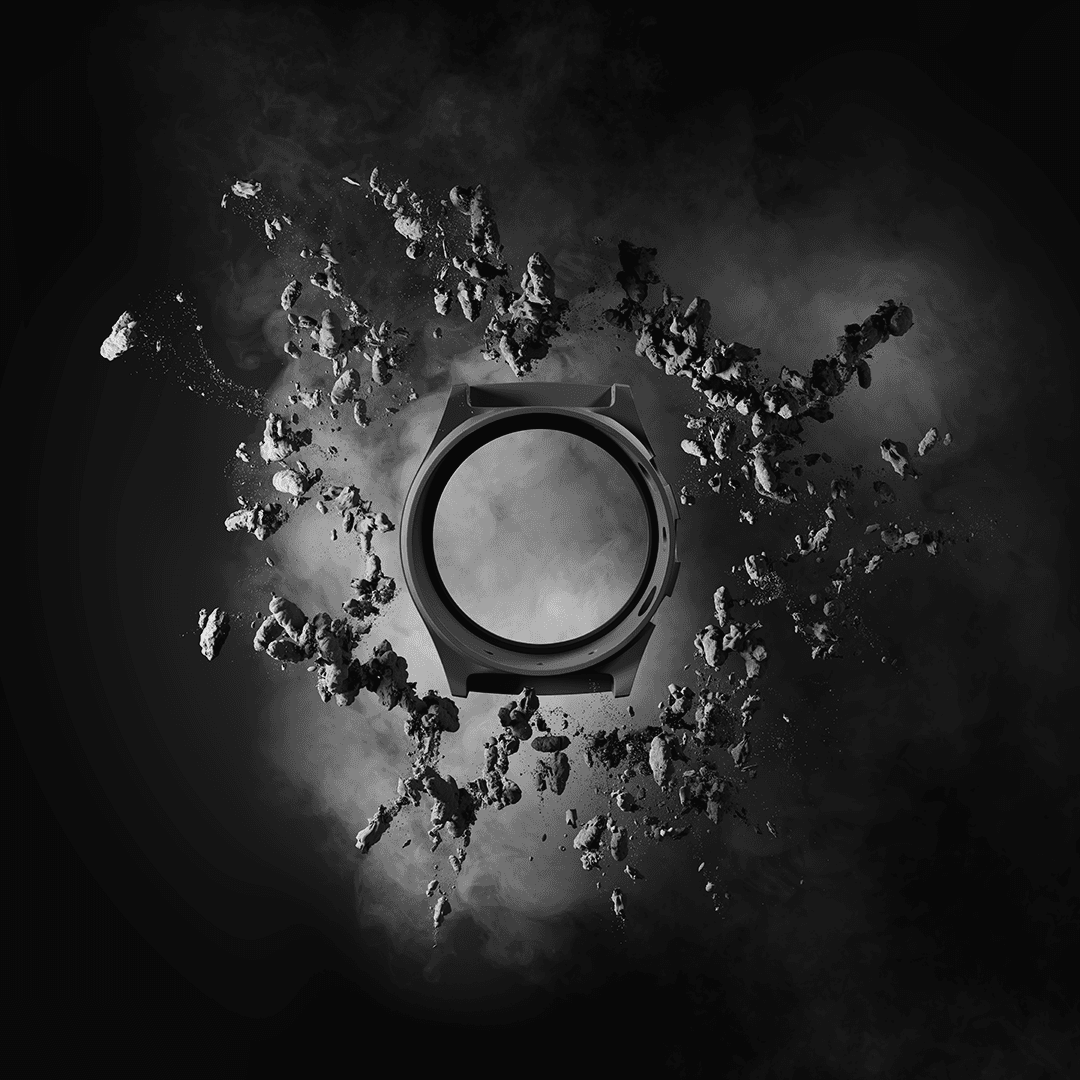
Porsche Design carries on the idea of the Black functional watch to this day – albeit with new technical means. While the original Chronograph I used chrome plating for its dark surface, today the brand increasingly uses titanium carbide as a coating and as a case material since 2023, a global innovation. This high-performance material is naturally dark, highly scratch-resistant and durable, while also being surprisingly lightweight.

For the wearer, this means that the watch retains its appearance for many years, even with intensive wear. Scratches are significantly reduced, while the light weight increases comfort. At the same time, the distinctly technical look that has characterised Porsche Design watches since the 1970s is retained. In titanium carbide, this continues a line that began with the coated Orfina chronographs. Titanium carbide combines two different concepts. All Black Chronograph 1 models receive a Black TiC coating, precisely applied, not glued on. The Chronograph 1 – 911 Dakar and the Chronograph 1 Utility go a step further and are made entirely of the newly developed material. Titanium carbide is not only a finish, it is the object itself. Its characteristic Grey is not an imitation of a colour, but an actual material property.

In the early decades, Porsche Design relied on the work of its partners for watchmaking technology. During the Orfina era, proven chronograph movements such as the Valjoux 7750 or the Lemania 5100 were used. At IWC and later at Eterna, these basics were combined with brand-specific solutions. With the founding of the Porsche Design Timepieces Manufactory in Switzerland, a new chapter began: a range of calibres were developed internally, specifically tailored to the brand's requirements.

An example of this is the WERK 01.140, a chronograph movement used in models such as the Chronograph 1 – 1972 Limited Edition. It combines the robustness of a proven architecture with chronometer-level regulation and a display designed entirely for readability. Rotor discs and bridges are designed to underline the technical character of the watch without being obtrusive. This makes the movement itself part of the design – not as an end in itself, but as a logical continuation of the original idea of subordinating each component to a clear purpose.
The innovation history of Porsche Design Timepieces is inconceivable without the aforementioned partners. With Orfina, the first Black serially produced chronograph became a reality. With IWC, the step into the titanium era was achieved, thus entering a new dimension of lightweight construction. With Eterna, structures were created that enabled the transition to clearly defined internal watchmaking.

In each of these phases, Porsche Design contributed its design and functional ideas, while the partners contributed their manufacturing expertise. The close collaboration laid the foundation for Porsche Design to later operate its own manufactory for timepieces. Behind all these collaborations, there was a clearly formulated objective from the very beginning. F. A. Porsche aimed to become an independent watch manufacturer, with its own expertise, its own production, its own voice in the industry.
With each partnership, this idea matured further, especially through the deep collaboration with Eterna, which for the first time enabled structural participation in production processes. This heritage is visible today in the Porsche Design Timepieces Manufactory. In independently designed calibres, the ongoing material development and knowledge transfer built on over five decades of watchmaking expertise are specifically carried forward into each new generation of timepieces. Today, these experiences are incorporated into the development of Porsche movements, materials, and concepts.

Looking back over the past five decades, innovation at Porsche Design is not just a collection of individual highlights, but a continuous thread. The Black chronograph of the Orfina era, the titanium models in collaboration with IWC, the structural development with Eterna, integrated concepts such as the Monobloc Actuator, new materials such as titanium carbide and internally developed calibres such as the WERK 01.140 are all part of the journey.

F. A. Porsche's credo was clearly put. ‘If you rethink the function of something, the form will follow naturally.’ At Porsche Design, function and design are not competing forces – they are equal, and their unity is the actual design objective. At its core, it is about thinking of the watch as a precise instrument, developed with the same consistency as a sports car. Every line, every material, and every technical decision is measured against this standard. For collectors and connoisseurs, this demonstrates the special role of Porsche Design in watchmaking. The brand not only continually reinterprets the icon from 1972, is also uses it as a starting point for ongoing development of function, material and form.
Professor Ferdinand Alexander Porsche and the idea that changed everything.

How Orfina, IWC, and Eterna helped shape the path to in-house watch manufacturing.
Change of delivery method
All products will be removed from your shopping basket
If you change the delivery method, all products will be removed from your shopping basket. This is for technical reasons, as some products are not available with all delivery methods.
