
The Birth of an Idea
Adrian travels to Zell am See to explore F. A. Porsche’s function‑first mindset and how it shaped the Chronograph 1.
All sizes shown for Porsche Lifestyle products are EU sizes. Please order one size larger for your standard North American size.
Professor Ferdinand Alexander Porsche and the idea that changed everything.

He designed the Porsche 911 – a vehicle that is still considered a benchmark for functional aesthetics – and transferred the same design philosophy to the wristwatch. In 1972, Ferdinand Alexander Porsche, nicknamed ‘Butzi’ by his family, posed a question that still drives Porsche Design Timepieces today: what is the most honest possible version of a timepiece? His answer established fundamental principles that have formed the framework ever since. Principles that have been consistently further developed with each generation within this framework. The principles are the same as with the vehicle. Technology, materials, and design, in turn, never stand still.
Born in 1935, F. A. Porsche grew up in a world where design and engineering were not separate disciplines. When he witnessed the creation of the Porsche 356 in 1948 at the age of 13 – the first car to define his father Ferry Porsche as an independent designer – a lifelong exploration of the question of what objects must look like to fully serve their purpose began. F. A. Porsche was the only member of his family to have received formal design training. In 1957, at the age of 22, he joined his father's design team. In 1960, he took over as head of the Porsche design department, and began to shape a design philosophy that remains relevant to this day.

In the 1960s, a different understanding of design dominated the automotive market. Opulence, chrome and decorative shapes – heavily influenced by American trends – characterised an industry where cars served as status symbols. F. A. Porsche took the opposite approach. With the Porsche 911, he designed a vehicle that refused to follow trends and instead set its own: understated, timeless, functionally consistent.
This approach did not stem from a marketing strategy, but from a deep conviction. Good design must be honest. It must not pretend to be more than it is. It must serve a purpose. F. A. Porsche applied these principles to the car just as he did later to the watch – and they explain why both remain so distinctive to this day.

In the 1960s, F. A. Porsche asked himself a very specific question: how can the cockpit of a race car help a driver to make faster and better decisions? He was not looking for the answer in engine power, but in perception.
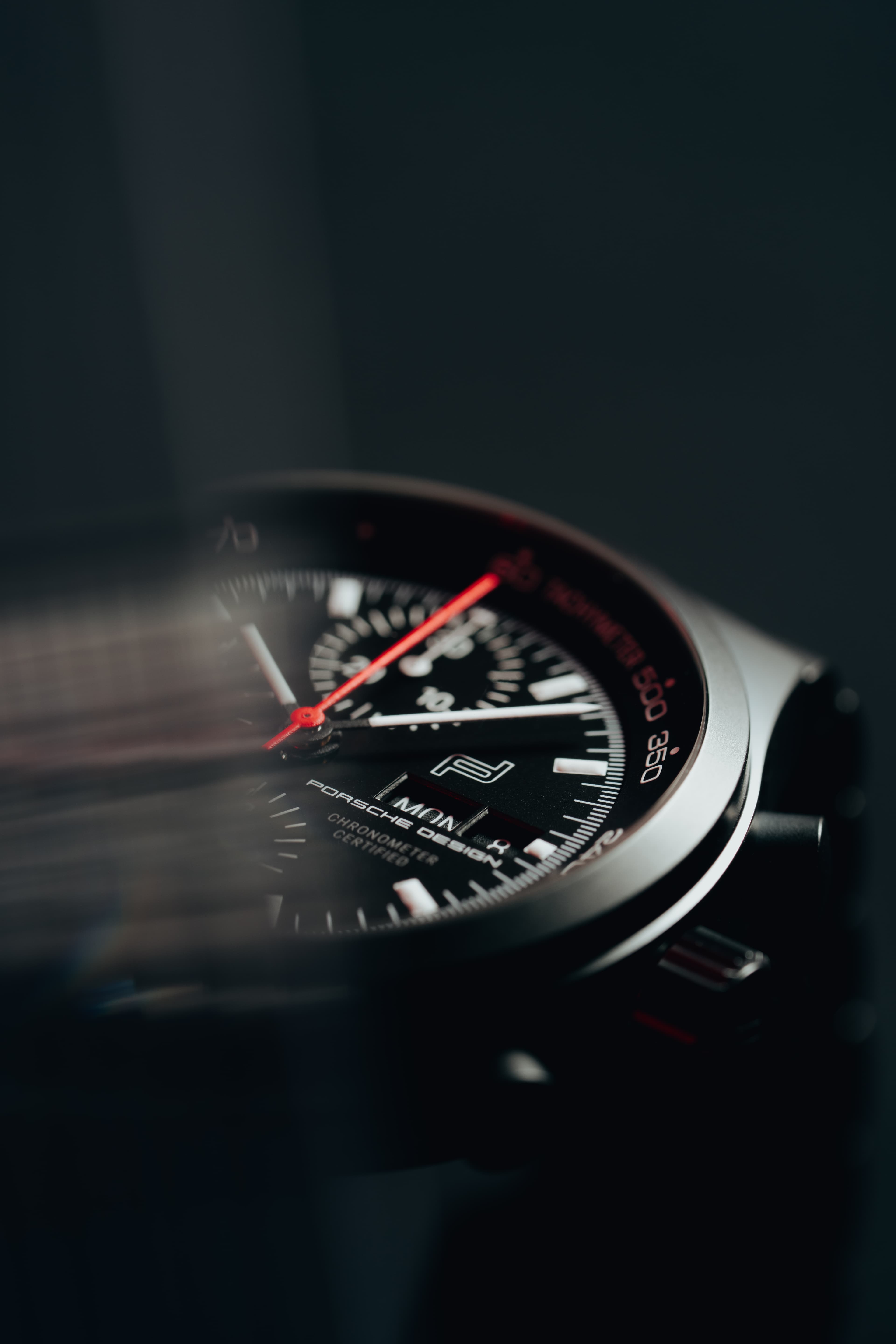
He began to rethink the instruments on the dashboard. Chrome on the dashboard reflects light and creates visual distractions in the driver's field of vision. His solution was radically simple. He replaced all of the chrome elements with matte Black surfaces. Then he turned his attention to the instruments themselves. Which background would make it easiest to read the display element? Which colour for the numerals and hands would maximise readability in tenths of a second? The result was a matte Black dial with White markings, a Signal Red hand. A system that doesn't strive to be more beautiful than necessary, and that enjoys almost unsurpassed functionality. This was the direct precursor to the Chronograph I.

In 1972, F. A. Porsche founded his own design studio, Studio F. A. Porsche, which was based in Zell am See from 1974 onwards. It was the logical outcome of years of conviction that good design needs its own space, separate from the day-to-day business of vehicle development. The first item this studio produced was not a new car body or interior concept. It was a watch. Because the watch is the pure essence of his understanding of design: an instrument that has a single function, where form and purpose must completely coincide.
The Chronograph I combined everything F. A. Porsche had learned: the cockpit principle in matte Black, the chronograph function as a direct reference to motorsport, and a conscious decision for a mechanical movement. The original manufacturing partner was Orfina. The relationship between Porsche Design and Orfina was characterised by a personal closeness from the very beginning. The first Chronograph I manufactured was presented to F. A. Porsche personally with his initials, F. A. P., engraved on the dial.
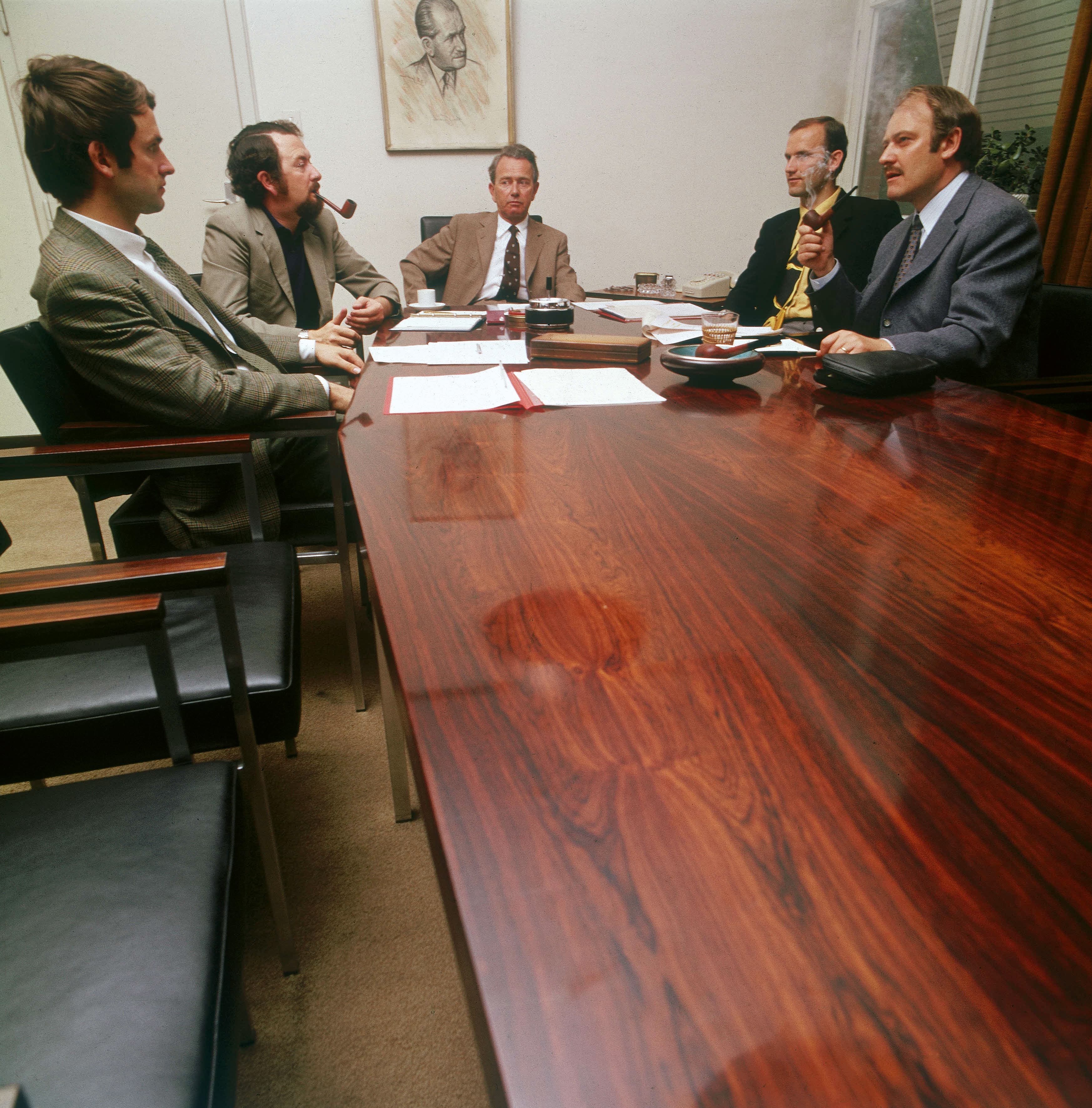
The order came from Porsche itself: the company commissioned the design of the Chronograph I – not as a product for the open market, but initially as an award for special loyalty. Originally, 25 watches were to be purchased annually to present to long-serving employees and those celebrating anniversaries. From this narrow circle, the watch gained a wider audience: loyal Porsche customers learned about it, racing drivers wore it, press photos showed it on famous wrists. An internal award became an object with its own gravitational pull.
F. A. Porsche's stance on price was unequivocal: an object that completely fulfils its purpose and retains its value permanently is always superior to a compromise – regardless of what it costs in the short term. At Porsche Design, quality is not a promise, but a design decision. The distribution of the Chronograph I was handled by F. A. Porsche's brother Hans-Peter, who built a service network that is still in operation today.

The functional consequences of the Chronograph I did not go unnoticed in the world. In the 1970s, the watch was adopted by several military units worldwide – including the Swiss Army, NATO, the German Bundeswehr, the Royal Air Force and the U.S. Air Force. These versions were not intended for the open market. They were tools designed for tough use under the most difficult conditions. The fact that the Swiss Army did not choose a traditional Swiss manufacturer, but rather Porsche Design, is a strong testament to the quality of this watch.
What F. A. Porsche started with the cockpit instrument for the racing driver has proven to be universally applicable. From racetracks to airbases, there is little need to justify an instrument that can be read in fractions of a second and that functions reliably under extreme stress. Between 1973 and 1991, 51,000 units of the Chronograph I were manufactured.

Adrian travels to Zell am See to explore F. A. Porsche’s function‑first mindset and how it shaped the Chronograph 1.

How the 911 instrument logic became a watch and why the Chronograph 1, shaped by motorsport and pure function, ultimately became an icon.

Adrian returns to Zell am See to explore materials, craft, and modern manufacturing, showing how the Chronograph 1 evolves without losing its purpose.

With the growing success of the Chronograph 1, Porsche Design sought new manufacturing partners. In 1977, a collaboration began with IWC Schaffhausen, resulting in the first joint model in 1978: a compass watch, considered one of the first watches with an integrated compass.
During this time, F. A. Porsche came into contact with a material through motorsport that immediately captivated him: titanium. Engine manufacturers discovered that titanium is lighter and stronger than steel, and it doesn't cause skin reactions. For F. A. Porsche, it was the next logical step: what works in the engine belongs on the wrist. In 1980, in collaboration with IWC, the first series-produced chronograph made entirely of titanium was created. Even today, titanium is still reserved for selected top models or special watches in the world of sports watches, which further underlines F. A. Porsche's idea from almost 50 years ago as a pioneering act.

The collaboration with Orfina ended in 1991. IWC temporarily took over sales and marketing, but it became clear that Porsche Design's own pace of innovation required a different structural framework. In 1995, Porsche Design acquired Eterna, a long-established Swiss watch manufacturer, to prepare for internal production. The cooperation with IWC ended in 1997. In the same year, to mark the 25th anniversary of the Chronograph 1, Porsche Design launched a special edition of 2,500 units which sold out in just a few days. It was an unmistakable sign that interest in the idea established by F. A. Porsche in 1972 remained unbroken. That year, his son Oliver joined the team as a product manager. The line from father to son, from idea to institution, became visible.

Studio F. A. Porsche in Zell am See is still active today. It is the place where the design signature of Porsche Design is preserved and further developed – with the same principles that F. A. Porsche established there in the early 1970s. With the founding of Porsche Design Timepieces AG in Solothurn, Switzerland, in 2014, a second centre was created: a Porsche manufactory where watches are developed and produced and this philosophy is transferred into every component.
Production processes are based on principles from sports car manufacturing: just-in-time thinking, zero tolerance for errors, uncompromising quality control. What applies on the racetrack also applies in the watch manufactory. Programs like Custom-built Timepieces add another dimension: individuality within a clear system logic. Buyers configure their watch in a similar way to how they configure a Porsche.
F. A. Porsche never designed for mainstream tastes. He designed for people who needed an instrument.

Professor Ferdinand Alexander Porsche never claimed to have invented watches. He asked only one, very consistent question: what is the most honest possible version of this object?
This question led to the creation of a Black chronograph in 1972. It combined high-performance materials like titanium with classic precision engineering at a time when the industry had no tools for doing so. It integrated the chronograph pusher into the case with the engineering spirit of motorsport. And it has led to the development of a completely new material: titanium carbide. A material from which entire housings are made, where the dark surface is not an applied layer, but a property of the material itself.
The answers change. The question remains. And it is the real reason why Porsche Design Timepieces not only builds watches, but also embodies an attitude.
From titanium to titanium carbide: materials that have changed the industry.

How Orfina, IWC, and Eterna helped shape the path to in-house watch manufacturing.
Change of delivery method
All products will be removed from your shopping basket
If you change the delivery method, all products will be removed from your shopping basket. This is for technical reasons, as some products are not available with all delivery methods.
